

暂无商品咨询信息 [发表商品咨询]

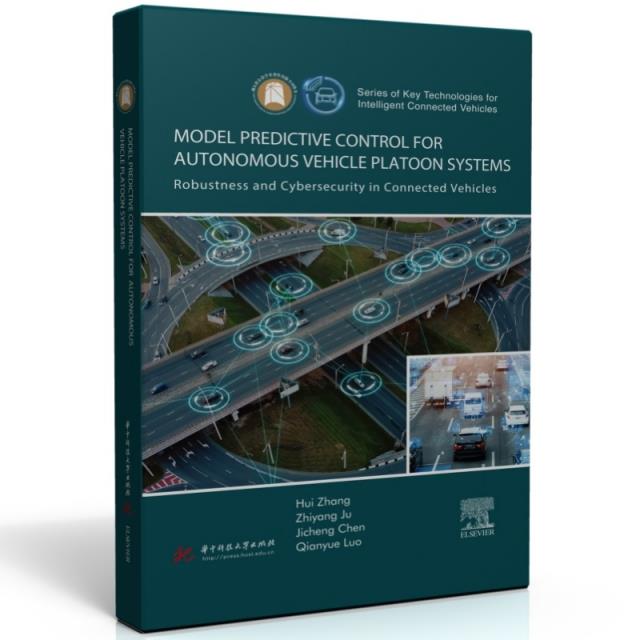
1.全面介绍最先进的联网和自动化车辆排系统的发展2.介绍了用于约束处理和鲁棒性改进的先进鲁棒和随机模型预测控制算法设计方法3.从稳健基于管的分布式MPC和随机基于管的分布MPC的角度介绍了严格的理论稳定性分析4.提供各种基于滤波器的车间攻击检测方法和基于事件的弹性车队控制设计方法
本书全面介绍了联网和自动化车辆排系统的设计。特别是,控制器设计部分考虑了鲁棒性和网络安全问题。将基于优化的模型预测控制方案应用于车队的控制。在控制器设计部分,考虑了约束处理、最优控制性能、抗干扰鲁棒性、抗网络攻击弹性等实际问题。这些主题涵盖了实用排系统设计的一般框架,并且可以广泛实现。同时,本书对排在不同控制方案下的稳定性进行了严格的理论分析。从基于鲁棒管的排控制器设计开始,发展到基于随机管的排控制、攻击检测和弹性排控制器设计,本书逐步解决了鲁棒性和网络安全问题。
张辉教授是中组部“Q人计划”特聘教授,北京航空航天大学教授、博士生导师,其先后主持国家重点研发计划课题、军委科技委项目、国家自然科学基金项目等多项研究课题,在IEEE、VSD等国际权威期刊上发表论文100余篇,其中第一作者SCI论文60余篇,连续四年被评为全球高被引科学家(北航仅两位专家入选)。现为Neurocomputing,SAE International Journal of Vehicle Dynamics, Stability, and NVH等期刊的副主编。多次受SAE邀请做大会主旨报告,是多个国际会议的主席、程序委员会主席、分会场主席等。2017年获得省部级自然科学一等奖1项。
ContentsPART 1 Vehicular platoon system design: fundamentals and robustness1 Introduction 31.1 Introduction 31.1.1 Background of attacks on CAVs 31.1.2 Security of CAVs 51.1.3 Scope of this survey 61.2 Preliminaries to attack detection and resilience for CAVs 81.2.1 Vehicle dynamics 81.2.2 Introduction to attacks in CAVs 131.2.3 Overview of the survey 151.3 Intra-vehicle network attack detection and resilience 171.3.1 Intra-vehicle network attack detection 171.3.2 Resilience strategies against intra-vehicle network attacks 221.4 Sensor attack detection and resilience 241.4.1 Sensor attack detection 241.4.2 Resilience strategies against sensor attacks 291.5 Inter-vehicle network attack detection and resilience 341.5.1 Inter-vehicle network attack detection 341.5.2 Resilience strategies against inter-vehicle network attacks 371.5.3 Security of CAVs containing malicious vehicles 411.6 Summary and future perspectives 43Acknowledgments 46References 462 Robust tube-based DMPC platoon control design 592.1 Introduction 592.2 Modeling and preliminaries 612.2.1 Vehicle longitudinal dynamics 612.2.2 Communication structure of vehicle platoons 632.2.3 Platooning control objectives 632.3 Control problem formulation 642.3.1 Feedback control and disturbance-compensation control 652.3.2 Distributed MPC feedforward control 682.4 Integrated control design procedure 762.4.1 Offline computation 762.4.2 Online control implementation 792.5 Simulation and comparison results 792.5.1 Scenario 1: Performance under disturbance effects 802.5.2 Scenario 2: Performance under acceleration/deceleration 872.6 Conclusions 88Acknowledgments 95References 953 Stochastic DMPC platoon control design 993.1 Introduction 993.2 Problem formulation 1023.2.1 Platoon model 1023.2.2 DSMPC problem for pltoons 1063.3 Tractable DMPC formulation 1083.3.1 Probailistic constraints reformulation 1083.3.2 Constraint tightening 1113.3.3 Terminal constraints design 1133.3.4 Approximated DMPC 1153.4 Recursive feasibility of the candidate solution 1163.5 Asymptotic performance of the stochastic DMPC scheme 1193.6 Simulations 1243.6.1 Simulation 1 1243.6.2 Simulation 2 1273.7 Conclusions 132Acknowledgments 132References 1334 Asynchronous self-triggered stochastic DMPC platoon control design 1374.1 Introduction 1374.2 Problem setup 1414.2.1 Platoon modeling 1414.2.2 Information flow and asynchronous self-triggered mechanism 1434.2.3 Objective 1454.3 Cost function and probabilistic constraints handling 1454.3.1 Asynchronous communication among vehicular platoon 1464.3.2 Cost function 1474.3.3 Probabilistic constraints handling 1494.4 Stochastic self-triggered DMPC scheme 1534.4.1 Stochastic self-triggered DMPC algorithm 1534.4.2 Analysis of theoretical properties 1544.5 Numerical examples 1574.5.1 Parameter selections and evaluation metrics 1584.5.2 Comparison with periodic time-triggered stochastic DMPC algorithm 1594.5.3 Evaluation of computational complexity, emergency braking safety and tuning parameters 1624.6 Conclusions 165Acknowledgments 166References 166PART 2 Advanced vehicular platoon system design: sampling security, resilience and event-triggered5 Attack detection using a UFIR estimator 1715.1 Introduction 1715.1.1 Background of attack detection in vehicle platoon systems 1725.1.2 Introduction of UFIR estimator and related attack estimation 1725.1.3 Main results 1735.2 Problem formulation 1745.2.1 Dynamic model of the local vehicle 1745.2.2 Problem formulation 1775.3 Failure of attack estimation using canonical FIR unknown input estimation 1795.3.1 Algorithm of a UFIR estimator without attack 1795.3.2 Failure of existing FIR-based unknown input estimation in attack detection 1815.4 Modified UFIR estimator for attack detection and estimation 1825.4.1 Modified UFIR estimator 1835.4.2 Properties of estimated intermediate results 1845.5 Attack detection and estimation 1925.5.1 Analysis of expectation of [m -1] 1925.5.2 Detection and estimation of the attack signal 1935.6 Simulation results 1965.6.1 Results of the modified UFIR estimator 1975.6.2 Results of the attack estimation 1995.7 Conclusion 201Acknowledgments 201References 2026 Distributed deception attack detection 2056.1 Introduction 2056.2 Problem formulation 2086.2.1 Communication protocol 2096.2.2 Dynamic model of an individual vehicle 2106.2.3 Distributed Kalman filters 2136.2.4 Deception attack detection and estimation problem 2156.3. Attack detection and estimation 2166.3.1 Attack detection and estimation using modiied GLR approach 2176.3.2 Attack identification based on modified GLR approach 2196.4 Simulation results and comparison 2216.4.1 x2 detector for attack detection 2216.4.2 Simulation results 2236.5 Conclusions 230Acknowledgments 230References 2307 Attack detection using moving horizon estimation 2357.1 Introduction 2357.2 Problem formulation 2377.2.1 Platoon modeling 2377.2.2 Cyberattack modeling 2377.3 Main results 2397.3.1 General framework 2397.3.2 Attack estimation using moving horizon estimation 2407.3.3 Attack-resilience distributed model predictive control 2417.4 Simulation examples 2427.4.1 Scenario's description 2427.4.2 Simulation results 2437.5 Conclusions 245Acknowledgments 247References 2478 Event-triggered resilient platoon control 2498.1 Introduction 2498.2 Problem formulation 2548.2.1 Longitudinal vehicle platoon model 2548.2.2 Information flow and packet transmission in VANET 2568.2.3 DoS attacks and detection 2578.2.4 DoS-attack-aware dynamic event-triggering condition 2588.2.5 Motivation example and control objectives 2618.3 Distributed event-triggered secure MPC against DoS attacks 2628.3.1 Event-triggered finite-horizon optimal control problem 2628.3.2 Vehicular beacon data packet structure 2648.3.3 Dynamic event-triggered distributed secure MPC algorithm 2658.4 Closed-loop properties of the DMPC algorithm 2678.4.1 Inter-sampling-time interval 2678.4.2 Feasibility analysis 2678.4.3 Stability analysis 2708.5 Numerical example 2738.5.1 Parameter selections and performance evaluation metric 2748.5.2 Evaluation of platooning under DoS-attack-aware dynamic event-triggered condition 2758.5.3 Evaluation of pltooning under various DoS attack durations 2768.6 Conclusion and future work 281Acknowledgments 283References 283Index 287
| 基本信息 | |
|---|---|
| 出版社 | 华中科技大学出版社 |
| ISBN | 9787577217741 |
| 条码 | 9787577217741 |
| 编者 | 张辉,巨志扬,陈继成,罗乾悦 著 |
| 译者 | -- |
| 出版年月 | 2026-05-01 00:00:00.0 |
| 开本 | 16开 |
| 装帧 | 精装 |
| 页数 | |
| 字数 | |
| 版次 | 1 |
| 印次 | |
| 纸张 | |
暂无商品评论信息 [发表商品评论]
暂无商品咨询信息 [发表商品咨询]
 官方微信
官方微信

