

暂无商品咨询信息 [发表商品咨询]


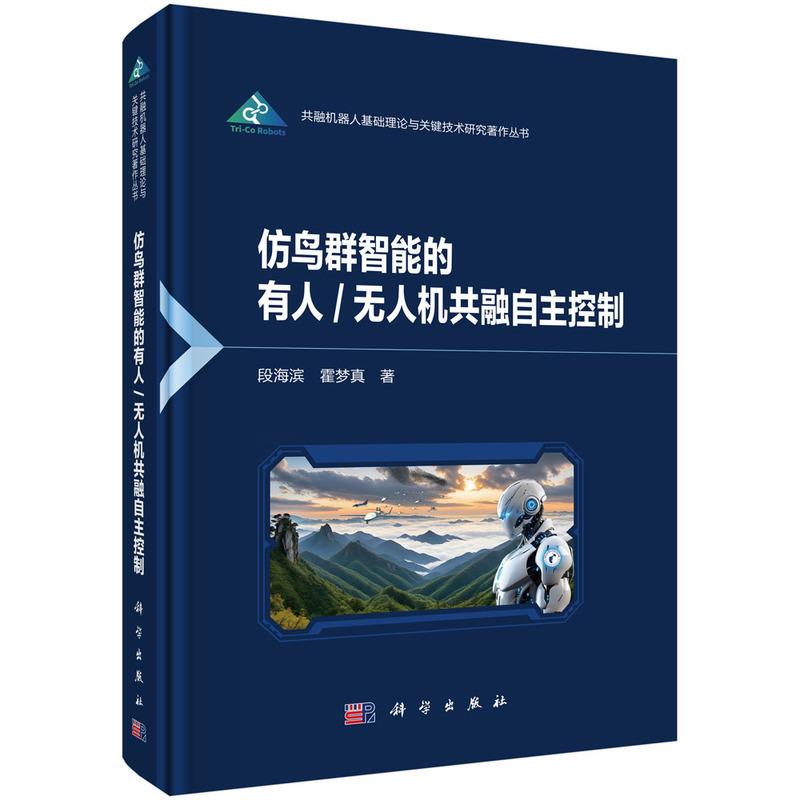
本书系统深入地论述仿鸟群智能的有人/无人机共融自主控制的原理、模型、理论、仿真及验证。全书共11章,概述鸟群智能和有人/无人机协同控制的新进展,在分析自然界中鸟群智能行为的基础上,建立鸽群、雁群、鹰群等典型鸟类的群体智能模型,研究从鸟群智能到有人/无人机共融集群控制的映射机理,设计基于鸟群智能的有人/无人机共融集群自主控制框架。针对动态编队、应急避障、进化博弈、群组对抗等关键技术难题,提出基于鸟群智能的有人/无人机共融集群自主控制理论与方法,并通过无人机集群集成试验平台验证相关技术。本书突出学术前沿,注重学科交叉,强调工程应用,力求使广大读者能快速掌握和应用有人/无人机仿生集群自主控制的理论、方法与技术。
目录
“共融机器人基础理论与关键技术研究著作丛书”序
序
前言
第1章 绪论 1
1.1 引言 1
1.2 有人/无人机协同 5
1.3 鸟群智能启发 9
1.4 技术挑战 16
1.5 本书结构 17
1.6 本章小结 18
参考文献 18
第2章 鸟群智能行为机制建模 25
2.1 引言 25
2.2 雁群同构V形编队建模 26
2.3 鸟群复合V形编队建模 29
2.4 雁群互惠合作机制建模 36
2.5 仿真分析 41
2.5.1 V形编队机制仿真分析 41
2.5.2 互惠合作机制仿真分析 44
2.6 本章小结 48
参考文献 49
第3章 人工干预下的鸟群智能行为机制建模 51
3.1 引言 51
3.2 鸽群归巢圆形盘旋建模 52
3.2.1 鸽群盘旋行为运动学建模 52
3.2.2 鸽群盘旋交互拓扑建模 53
3.3 人工干预下鸽群避障行为建模 61
3.3.1 人工干预下的鸽群避障逃逸行为实验 62
3.3.2 人工干预下的鸽群转向机制建模 69
3.3.3 人工干预下的鸽群分裂机制建模 73
3.4 仿真分析 75
3.4.1 鸽群避障行为数据统计及分析 75
3.4.2 人工干预下鸽群避障行为仿真分析 79
3.5 本章小结 81
参考文献 82
第4章 有人/无人机共融集群交互建模 86
4.1 引言 86
4.2 有人/无人机共融模式设计 86
4.3 有人/无人机共融模式切换 92
4.3.1 飞行员工作负荷评估建模 93
4.3.2 有人/无人自动化信任度建模 95
4.3.3 人机共融模式自适应切换方法 99
4.4 基于模仿学习的交互技术 103
4.4.1 有人/无人机集群信任度模仿学习 104
4.4.2 有人/无人机信任度学习仿真分析 107
4.5 本章小结 108
参考文献 108
第5章 有人/无人机共融集群动力学建模 113
5.1 引言 113
5.2 有人/无人机动力学建模 114
5.2.1 基于鸟群捕食-逃逸行为的动力学建模 119
5.2.2 不同人机共融模式下的动力学建模 122
5.3 仿真分析 126
5.3.1 参数指标 126
5.3.2 仿真实验 127
5.4 本章小结 136
参考文献 136
第6章 仿鸟群有人/无人机共融集群编队控制 140
6.1 引言 140
6.2 有人/无人机共融集群编队队形库设计 141
6.3 有人/无人机共融集群变拓扑重构控制 145
6.4 仿雁群智能的有人/无人机集群编队控制 148
6.4.1 有人/无人机集群空间编队控制 148
6.4.2 基于有人机指令的无人机集群控制 152
6.4.3 仿雁群编队的有人/无人机编队控制 155
6.5 仿真分析 157
6.5.1 有人/无人机编队控制方法仿真分析 157
6.5.2 有人/无人机编队变拓扑控制仿真分析 163
6.5.3 仿雁群智能的有人/无人机编队变拓扑仿真分析 167
6.6 本章小结 174
参考文献 174
第7章 仿鸟群有人/无人机共融集群避障控制 176
7.1 引言 176
7.2 仿鸽群智能的共融集群盘旋控制 177
7.2.1 盘旋问题描述 177
7.2.2 盘旋控制方法设计 178
7.2.3 盘旋控制收敛性分析 181
7.3 仿鸽群智能的有人/无人机避障控制 186
7.3.1 非转弯段有人/无人机共融集群协同运动控制 187
7.3.2 转弯段有人/无人机共融集群协同运动控制 194
7.4 仿真分析 195
7.4.1 仿鸽群智能的集群盘旋仿真分析 195
7.4.2 仿鸽群智能的集群避障仿真分析 201
7.5 本章小结 204
参考文献 204
第8章 仿鸟群有人/无人机共融集群进化博弈 206
8.1 引言 206
8.2 网络进化博弈模型 207
8.2.1 基本博弈模型 209
8.2.2 个体适应度与更新规则 209
8.3 集群对抗态势评估算法 210
8.3.1 个体态势评估 211
8.3.2 集群态势评估 212
8.4 基于网络进化博弈的集群对抗战术决策 214
8.4.1 战术任务序列分解 214
8.4.2 战术决策协同生成 219
8.5 仿真分析 221
8.6 本章小结 228
参考文献 228
第9章 仿鸟群有人/无人机共融群组博弈对抗 230
9.1 引言 230
9.2 鹰鸽空间演化机制 231
9.2.1 鹰群协同狩猎策略 231
9.2.2 鸽群协同防御策略 234
9.2.3 空间演化机制建模 236
9.3 仿鹰鸽智能的群组博弈控制 240
9.3.1 仿鹰鸽群组博弈建模 240
9.3.2 仿鹰狩猎机制的目标选择战术 243
9.3.3 仿鹰攻击机制的自适应拦截控制 246
9.3.4 仿鸽群逃逸机制的群组协同控制 247
9.4 基于鹰鸽博弈的无人机群组控制策略 249
9.4.1 鹰鸽博弈拦截时间推导 249
9.4.2 鹰鸽博弈获胜区域估计 251
9.5 仿真分析 256
9.5.1 基地四周分散交战仿真分析 257
9.5.2 基地一侧密集交战仿真分析 263
9.6 本章小结 270
参考文献 270
第10章 仿鸟群有人/无人机共融集群集成验证 272
10.1 引言 272
10.2 三维视景仿真环境构建 273
10.3 仿鸟群有人/无人机集群仿真验证 282
10.4 仿鸟群有人/无人机集群飞行验证 285
10.5 本章小结 289
参考文献 289
第11章 研究前沿与展望 291
11.1 引言 291
11.2 发展趋势 293
11.3 关键技术 295
11.3.1 鸟群智能理论与方法 295
11.3.2 有人/无人机共融集群自主控制 296
11.4 应用领域 298
11.5 本章小结 299
参考文献 299
Contents
Foreword to the Series of Works on the Basic Theory and Key Technologies of Tri-Co Robots
Foreword
Preface
Chapter 1 Exordium 1
1.1 Introduction 1
1.2 Manned/Unmanned Aerial Team Coordination 5
1.3 Biological Inspiration of Bird Flocks 9
1.4 Technical Challenges 16
1.5 Organization of This Book 17
1.6 Summary 18
References 18
Chapter 2 Intelligent Bird Behavior Model of Bird Flocks 25
2.1 Introduction 25
2.2 Homogeneous V-Formation Model of Geese 26
2.3 Heterogeneous V-Formation Model of Birds 29
2.4 Reciprocal Cooperation Model of Geese 36
2.5 Simulation Analysis 41
2.5.1 Simulation of V-Formation Model 41
2.5.2 Simulation of Reciprocal Cooperation Model 44
2.6 Summary 48
References 49
Chapter 3 Intelligent Bird Behavior Model under Human Intervention 51
3.1 Introduction 51
3.2 Circling Model of Homing Pigeon 52
3.2.1 Kinematic Model of Pigeon Circling Behavior 52
3.2.2 Topology Model of Pigeon Interaction 53
3.3 Obstacle Avoidance Model under Human Intervention 61
3.3.1 Obstacle Avoidance and Escaping Experiments under Human Intervention 62
3.3.2 Steering Mechanism Model under Human Intervention 69
3.3.3 Division Mechanism Model under Human Intervention 73
3.4 Simulation Analysis 75
3.4.1 Statistical Analysis of Pigeon Flock Data 75
3.4.2 Simulation Analysis of Pigeon Obstacle Avoidance 79
3.5 Summary 81
References 82
Chapter 4 Interaction Model of Tri-Co Manned/Unmanned Aerial Team 86
4.1 Introduction 86
4.2 Cooperation Mode of Tri-Co Manned/Unmanned Aerial Team 86
4.3 Mode Switching of Tri-Co Manned/Unmanned Aerial Team 92
4.3.1 Evaluation Model of Pilot Workload 93
4.3.2 Autonomy and Trust Model of Manned/Unmanned Team 95
4.3.3 Adaptive Switching Method for Manned/Unmanned Tri-Co Modes 99
4.4 Interaction Method Based on Imitation Learning 103
4.4.1 Imitation Learning for Human-Swarm Trust 104
4.4.2 Simulation Analysis of Human-Swarm Trust 107
4.5 Summary 108
References 108
Chapter 5 Dynamic Model of Tri-Co Manned/Unmanned Aerial Team 113
5.1 Introduction 113
5.2 Dynamic Models of Manned/Unmanned Aircrafts 114
5.2.1 Dynamic Model Based on Predation-Escape Behavior 119
5.2.2 Dynamic Model under Different Cooperation Modes 122
5.3 Simulation Analysis 126
5.3.1 Parameters and Indicators 126
5.3.2 Simulation Experiments 127
5.4 Summary 136
References 136
Chapter 6 Bird-Inspired Tri-Co Manned/Unmanned Formation Control 140
6.1 Introduction 140
6.2 Formation Library of Tri-Co Manned/Unmanned Aerial Team 141
6.3 Formation Reconfiguration Control of Tri-Co Team 145
6.4 Geese-Inspired Manned/Unmanned Formation Control 148
6.4.1 Cluster Space Formation Control Method 148
6.4.2 Cluster Control of Swarm under Human Command 152
6.4.3 Formation Control Method Inspired by Geese 155
6.5 Simulation Analysis 157
6.5.1 Simulation of Formation Control Method 157
6.5.2 Simulation of Formation Reconfiguration Method 163
6.5.3 Simulation of Geese-Inspired Formation Reconfiguration Method 167
6.6 Summary 174
References 174
Chapter 7 Bird-Inspired Tri-Co Manned/Unmanned Obstacle Avoidance Control 176
7.1 Introduction 176
7.2 Swarm Circling Control Based on Pigeon Intelligence 177
7.2.1 Model Description of Circling Control Problem 177
7.2.2 Design of Circling Control Method 178
7.2.3 Convergence Analysis of Circling Control 181
7.3 Obstacle Avoidance Based on Pigeon Intelligence 186
7.3.1 Cooperative Control in Non-Turning Period 187
7.3.2 Cooperative Control in Turning Period 194
7.4 Simulation Analysis 195
7.4.1 Simulation of Circling Control Method 195
7.4.2 Simulation of Obstacle Avoidance Method 201
7.5 Summary 204
References 204
Chapter 8 Bird-Inspired Tri-Co Manned/Unmanned Evolutionary Game 206
8.1 Introduction 206
8.2 Model of Network Evolutionary Game 207
8.2.1 Description of Network Evolutionary Game 209
8.2.2 Individual Fitness and Renewal Rules 209
8.3 Situation Evaluation Method of Team 210
8.3.1 Situation Evaluation of the Agent 211
8.3.2 Situation Evaluation of the Swarm 212
8.4 Adversarial Tactical Based on Evolutionary Game 214
8.4.1 Simulation of Tactical Task Sequence Decomposition 214
8.4.2 Simulation of Collaborative Generation of Tactical Decisions 219
8.5 Simulation Analysis 221
8.6 Summary 228
References 228
Chapter 9 Bird-Inspired Tri-Co Manned/Unmanned Game Confrontation 230
9.1 Introduction 230
9.2 Spatial Evolution Mechanism of Hawk-Pigeon 231
9.2.1 Cooperative Hunting Strategy of Hawks 231
9.2.2 Cooperative Defense Strategy of Pigeon Flocks 234
9.2.3 Model of Spatial Evolution Mechanism 236
9.3 Group Game Model Based on Hawk-Pigeon 240
9.3.1 Group Game Model Inspired by Hawk-Pigeon 240
9.3.2 Target Selection Strategy Inspired by Hawk 243
9.3.3 Adaptive Interception Strategy Inspired by Hawk 246
9.3.4 Group Cooperation Strategy Inspired by Pigeon 247
9.4 Group Control Strategy Based on Hawk-Pigeon Game 249
9.4.1 Interception Time Derivation of Hawk-Pigeon Game 249
9.4.2 Winning Areas Estimation of Hawk-Pigeon Game 251
9.5 Simulation Analysis 256
9.5.1 Simulation of Scattered Fighting Around the Combat Base 257
9.5.2 Simulation of Engagement on One Side of the Combat Base 263
9.6 Summary 270
References 270
Chapter 10 Integrated Verification of Bird-Inspired Tri-Co
Manned/Unmanned System 272
10.1 Introduction 272
10.2 Construction of 3D Visual Simulation Environment 273
10.3 Simulation Verification of Bird-Inspired Manned/Unmanned Team 282
10.4 Flight Verification of Bird-Inspired Manned/Unmanned Team 285
10.5 Summary 289
References 289
Chapter 11 Frontier and Prospect 291
11.1 Introduction 291
11.2 Development Tendency 293
11.3 Key Technology 295
11.3.1 Intelligent Theory and Method of Bird Flocks 295
11.3.2 Autonomous Control of Manned/Unmanned Aerial Team 296
11.4 Application Field 298
11.5 Summary 299
References 299
| 基本信息 | |
|---|---|
| 出版社 | 科学出版社 |
| ISBN | 9787030851444 |
| 条码 | 9787030851444 |
| 编者 | 段海滨 著 |
| 译者 | -- |
| 出版年月 | 2026-05-01 00:00:00.0 |
| 开本 | B5 |
| 装帧 | 精装 |
| 页数 | 330 |
| 字数 | 400000 |
| 版次 | 1 |
| 印次 | |
| 纸张 | |
暂无商品评论信息 [发表商品评论]
暂无商品咨询信息 [发表商品咨询]
 官方微信
官方微信

